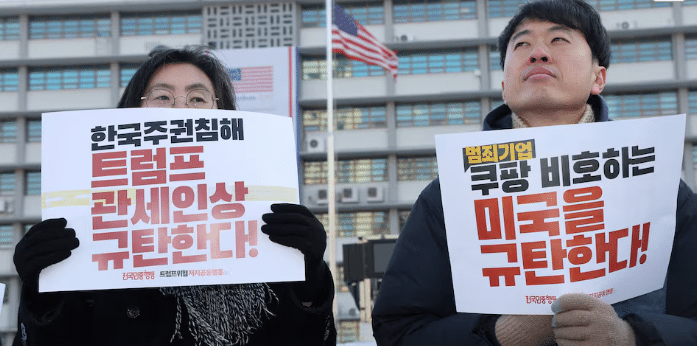

Former U.S. President Donald Trump has announced plans to raise tariffs on a range of South Korean imports to 25%, escalating trade tensions with one of Washington’s key Asian allies.
Trump said the decision was prompted by delays in South Korea’s legislature approving a previously agreed trade deal between the two countries. The agreement, negotiated last year, was intended to lower U.S. tariffs on certain South Korean goods in exchange for large-scale investment commitments from Seoul in the United States.
In a social media post, Trump accused South Korea’s National Assembly of failing to act on what he described as a “historic” trade agreement, arguing that the United States was justified in imposing higher “reciprocal tariffs” as a result.
Market Reaction and Economic Impact
The announcement triggered volatility in financial markets. Shares of major South Korean automakers fell sharply in early trading before recovering some of their losses, while the South Korean won weakened against the U.S. dollar.
Uncertainty remains over the timing and scope of the tariff increase, raising concerns among investors and businesses on both sides of the Pacific.
Seoul Seeks Talks
South Korean officials said they had not received formal notification of the tariff hike and stressed that diplomatic and trade discussions with Washington were ongoing. The presidential office confirmed that the country’s trade minister is expected to travel to Washington to seek clarification and prevent further escalation.
The stalled trade agreement had been promoted as a way to deepen economic cooperation, with reduced tariffs on key exports such as automobiles and expanded South Korean investment in U.S. industries. However, delays in legislative approval have now put the deal in doubt.
Broader Implications
The tariff move risks straining economic and strategic ties between the United States and South Korea, long-standing partners in trade and security. Economists warn that higher tariffs could disrupt supply chains and raise costs for businesses and consumers.
Trump’s decision reflects his long-standing approach to trade policy, which emphasizes tariffs as a tool to pressure trading partners into renegotiating agreements he views as unfavorable to the United States.