
The United States has begun assembling a significant concentration of naval and air power near Iran, prompting analysts to question whether Washington is preparing for another military operation against Tehran.
In recent days, US forces have moved high-value assets into the Arabian Sea, a pattern that closely resembles deployments seen ahead of past American strikes. While US officials insist the build-up is precautionary, experts say the scale and timing of the movements are hard to ignore.
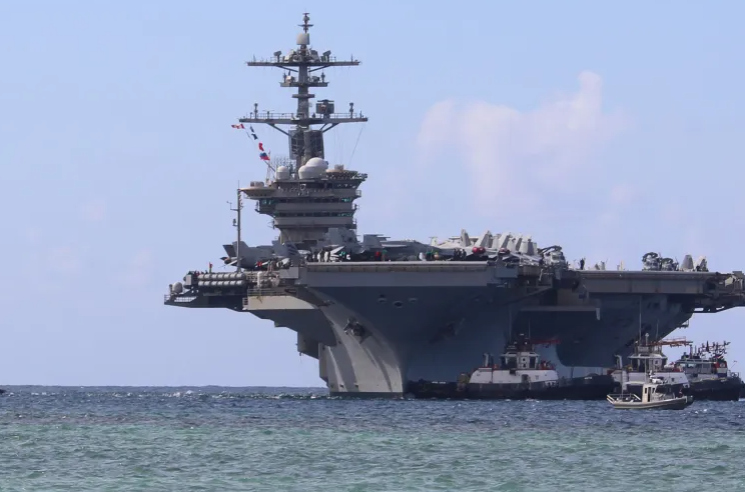
At the centre of the deployment is the USS Abraham Lincoln, a nuclear-powered aircraft carrier that now anchors a growing US naval presence in waters off Iran.
Echoes of the June 2025 Iran Strikes
The current military activity has drawn comparisons with June 2025, when the United States joined Israel during a brief but intense conflict and launched direct attacks on Iranian nuclear facilities. At that time, US forces quietly positioned carrier groups, stealth bombers and missile-capable submarines before executing coordinated strikes across Iran.
Washington has also demonstrated similar behaviour elsewhere. Last year, US forces quietly amassed assets in the Caribbean before carrying out strikes against Venezuelan vessels accused of drug trafficking, followed by a dramatic military operation that resulted in the seizure of President Nicolás Maduro.
Those precedents have heightened speculation that the latest deployment near Iran could signal more than routine deterrence.
Political Tensions Add to Military Pressure
The renewed military focus comes amid political turmoil inside Iran. Protests that erupted late last year over economic hardship quickly evolved into wider demonstrations against the government. Iranian security forces were accused of violently suppressing the unrest, with UN officials estimating thousands of deaths and mass detentions.
US President Donald Trump sharply criticised Iran’s leadership during the protests, publicly backing demonstrators and warning Tehran against carrying out executions. Although Trump later said Iranian authorities had assured him that executions would not proceed, tensions have remained high.
Speaking aboard Air Force One last week, Trump confirmed that additional US forces had been moved closer to Iran, describing the deployment as a contingency measure.
“We have a massive fleet heading in that direction,” he said. “Maybe we won’t have to use it.”
At the same time, he warned that any executions carried out by Iran would trigger a response far more severe than the June 2025 strikes.
What Forces Has the US Deployed?
US Central Command has confirmed the arrival of the USS Abraham Lincoln in the Middle East, describing the move as part of efforts to ensure regional security. The carrier, one of the largest warships in the US Navy, carries a full strike group that includes guided-missile destroyers, support vessels and thousands of personnel.
The Abraham Lincoln is accompanied by several Arleigh Burke-class destroyers, warships capable of launching long-range Tomahawk missiles and defending against ballistic missile threats. These vessels provide both offensive and defensive coverage for the carrier group.
Meanwhile, the US Air Forces Central Command has announced large-scale readiness drills across its operational zones, which span dozens of countries in the Middle East, Asia and Africa. Officials say the exercises are designed to improve rapid deployment and combat preparedness, though details about locations and timelines have not been disclosed.
The US already maintains an extensive military footprint in the region, with tens of thousands of troops stationed across multiple countries and a network of permanent bases stretching from the Gulf to the eastern Mediterranean.
Capabilities of the USS Abraham Lincoln
The USS Abraham Lincoln functions as a floating airbase, capable of launching sustained air operations far from US shores. Powered by nuclear reactors, the carrier can operate for years without refuelling and travel at high speeds to reposition quickly during a crisis.
Its onboard air wing includes dozens of fighter jets, primarily F/A-18 Super Hornets, which are used for precision strikes, air defence and reconnaissance. The same air wing has previously participated in US operations against Houthi forces in Yemen.
Together with escort ships and potentially a submarine, the carrier strike group gives Washington the ability to conduct air and missile attacks, enforce blockades, or project power deep inland.
A Reminder of Operation Midnight Hammer
The deployment has revived memories of Operation Midnight Hammer, the June 2025 US assault on Iran’s nuclear infrastructure. During that mission, American forces struck facilities at Fordow, Natanz and Isfahan in a highly coordinated overnight operation involving more than 100 aircraft and advanced munitions.
B-2 stealth bombers dropped massive bunker-buster bombs on deeply buried sites, while cruise missiles were launched from submarines. The operation marked the first direct US strikes on Iranian territory and significantly damaged Tehran’s nuclear programme.
Iran responded days later with a limited missile attack on a US base in Qatar, an action widely viewed as symbolic rather than escalatory.
Is Another Strike Likely?
Analysts are divided on whether the latest build-up signals imminent action. Some argue that the deployment could support a limited strike aimed at pressuring Iran’s leadership or deterring further domestic repression.
Others caution that a military operation would carry serious risks. Iran retains the ability to retaliate across the region, target US troops and allies, disrupt global energy supplies, or escalate tensions with Israel.
Experts also warn that military action could strengthen hardliners inside Iran rather than weaken them, with civilians likely to bear the heaviest costs.
For now, US officials maintain that the deployment is defensive. But as history has shown, similar movements in the past have often preceded decisive — and sudden — action.
Whether this show of force is meant as a warning or a prelude remains an open question.