
The United Kingdom and France have said they are prepared to deploy troops to Ukraine if a ceasefire is reached, marking a significant step in European security planning amid ongoing peace negotiations with Russia.
The announcement followed a high-level summit in Paris hosted by French President Emmanuel Macron, where leaders from more than two dozen allied nations gathered under the banner of a so-called “coalition of the willing.”
Trilateral Declaration Signed in Paris
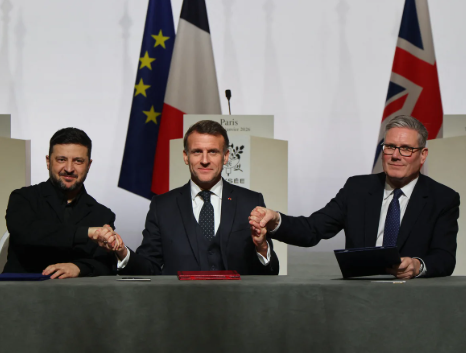
After hours of talks, Macron, UK Prime Minister Keir Starmer and Ukrainian President Volodymyr Zelenskyy signed a trilateral declaration of intent.
The document sets out plans for British and French troops to be stationed in Ukraine following a ceasefire, including the creation of military coordination hubs across the country. Starmer said the presence would be designed to support stability rather than frontline combat.
Mission Aimed at Deterrence, Not Combat
Macron stressed that any deployed force would remain far from active battle lines and would not engage directly with Russian troops if fighting resumes. Instead, the mission would focus on reassurance, ceasefire monitoring, and long-term backing for Ukraine’s armed forces.
No details were provided on troop numbers or the precise timeline for deployment.
US Signals Support for Security Guarantees
The Paris talks were attended by US envoy Steve Witkoff and Jared Kushner, representing President Donald Trump. Witkoff said the proposed security guarantees were intended to deter further attacks and reassured allies that Washington stood firmly behind the framework.
He added that the United States would continue supporting Ukraine in efforts to secure a lasting peace agreement.
Territorial Disputes Remain a Major Obstacle
Despite diplomatic momentum, major challenges remain. Zelenskyy confirmed that territorial concessions are still a sticking point in talks between Ukrainian and US negotiators. He said he was prepared to engage directly with Trump if negotiations stalled.
Witkoff acknowledged that territory would be the most difficult issue to resolve, suggesting compromises may be necessary.
Russia Likely to Oppose Any Nato Presence
Moscow has repeatedly ruled out accepting Nato or Western troops on Ukrainian soil and continues to demand a broader settlement addressing what it calls the “root causes” of the conflict.
Russian officials have also rejected the idea of a short-term ceasefire, raising doubts about how soon any post-ceasefire deployment could realistically occur.
European Allies Divided on Troop Contributions
While the Paris summit drew 27 heads of state or government, not all countries are willing to commit forces. Italy and Poland confirmed they would not send troops to Ukraine, while Germany said it could contribute only from neighbouring countries.
Starmer acknowledged the uncertainty, saying progress toward peace was closer than before but still dependent on Russia’s willingness to compromise.
Ukraine Says Commitments Must Be Meaningful
Zelenskyy warned that the credibility of the coalition depends on real commitments, not just declarations. He said British and French troop pledges were vital to making any future security guarantees effective.
“If countries are not ready to step up,” he said, “then it is not truly a coalition of the willing.”