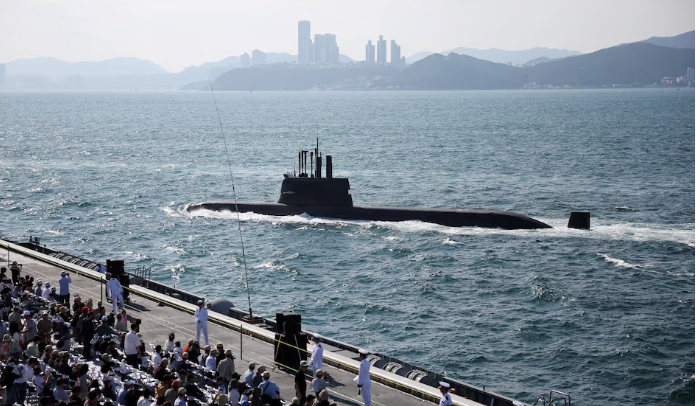

South Korea’s long-standing ambition to operate nuclear-powered submarines is accelerating after U.S. President Donald Trump signalled his support — a shift that could reshape the balance of power in Asia and ignite a regional contest beneath the waves.
For decades, Washington resisted requests from Seoul to access nuclear fuel for military propulsion. That resistance appears to have eased, removing a crucial barrier and energising South Korea’s defence establishment. Officials in Seoul argue that the move is essential to counter North Korea’s expanding underwater capabilities.
Seoul’s Strategic Leap Raises Regional Alarms
South Korea’s rapid progress is already unsettling its neighbours. Analysts warn that the introduction of nuclear submarines — faster, stealthier and capable of staying submerged for months — could pressure Japan to follow suit and provoke new friction with China.
“Once a nuclear submarine enters the fleet, the strategic landscape changes,” said Choi Il, a retired South Korean Navy submarine captain. “Regional competition will be unavoidable.”
President Lee Jae Myung hailed the agreement emerging from his meeting with Trump, calling it a major breakthrough that boosts South Korea’s defence autonomy. Seoul maintains it is not pursuing nuclear weapons and remains committed to global non-proliferation norms.
North Korea Claims to Be Developing Nuclear Submarines
North Korea, meanwhile, insists it is developing its own nuclear-powered submarine. State media has showcased leader Kim Jong Un inspecting what it described as a newly developed vessel, though analysts believe Pyongyang is still far from fielding an operational platform. Some in Seoul suspect Russian technical assistance — an allegation North Korea and Russia deny but have not fully clarified.
South Korea’s military says it is monitoring the possibility of Russian involvement “very closely.”
Japan Faces Pressure as U.S. Backs Seoul
Japan was reportedly stunned by Washington’s change of posture. Tokyo has long believed that if the U.S. were to support nuclear propulsion in the region, Japan would be the natural first partner. The shift in priority toward Seoul has prompted internal debate.
Defence Minister Shinjiro Koizumi has said nuclear propulsion is theoretically an option for Japan, although the ministry insists no formal review is underway. A Japanese official said any future nuclear-submarine programme would require U.S. cooperation.
Naval experts note that Japan’s current diesel-electric fleet excels in shallow waters, but nuclear submarines would enable extended Pacific operations and potentially lay the groundwork for a second-strike capability.
Boosting Washington’s Strategy Against China
South Korea’s submarine ambitions dovetail with U.S. goals in the Indo-Pacific, particularly those aimed at countering China’s expanding naval power. Admiral Daryl Caudle, the U.S. Chief of Naval Operations, recently called China a “pacing threat” and suggested Seoul’s nuclear submarines could become an important part of regional deterrence.
Beijing has kept its reaction muted so far, but analysts caution that China could harden its position as the programme advances.
Last month, President Lee assured Chinese leader Xi Jinping that the submarines will serve purely defensive purposes aimed at deterring North Korea. North Korean media, however, has warned that the initiative could unleash a “nuclear domino” effect across the region.
A Project Decades in the Making
Only six countries currently operate nuclear-powered submarines — the U.S., U.K., Russia, China, France and India — with Australia developing its own fleet through the AUKUS partnership.
South Korea first explored nuclear submarines during the 1994 North Korean nuclear crisis. The concept resurfaced repeatedly, including during the Moon Jae-in administration in 2017, but U.S. proliferation concerns stalled earlier efforts.
Those concerns have not completely disappeared. Former Vice Foreign Minister Choi Jong Kun noted that American defence and energy officials remained wary of nuclear-propulsion transfers for years.
Seoul Moves Ahead: “The Train Is Already Moving”
Despite past obstacles, South Korea has steadily advanced the project on its own. Retired naval officials say the country has already developed core submarine designs, while reactor assembly work is reportedly at a “significant” stage.
Defence Minister Ahn Gyu-back recently told parliament that South Korea could field its first nuclear submarine within roughly a decade, with a minimum requirement for four 5,000-tonne vessels.
A U.S.–South Korea fact sheet released on November 14 confirmed Washington’s agreement to cooperate on sourcing nuclear fuel — a step Seoul sees as the final piece needed to begin construction.
“We were already preparing the conditions,” Ahn said. “Fuel was the key.”
The defence ministry says it is steadily acquiring necessary technologies and will continue cooperating with the United States while emphasising safety and compliance.
A White House official said the U.S. supports South Korea’s desire to “share more of the security burden” and enhance deterrence.
According to former vice minister Choi, Australia’s AUKUS deal helped break down longstanding taboos surrounding nuclear-propulsion collaboration.
“The train is already moving,” he said. “The door is open — there is still more work to do, but the direction is set.”