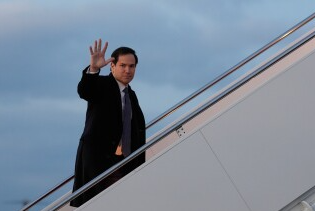

Marco Rubio has warned that the world is entering a “new era” in geopolitics as he prepares to address global leaders at the Munich Security Conference.
Speaking before his departure to Germany, Rubio described the current moment as a defining turning point for international alliances, particularly between the United States and Europe.
A Changing Transatlantic Relationship
Rubio will lead the US delegation at the high-profile conference, the first major global security gathering since President Donald Trump renewed controversial remarks about annexing Greenland, a semi-autonomous territory of Denmark.
The comments have unsettled European leaders and added strain to already tense transatlantic ties.
French President Emmanuel Macron has urged Europe to strengthen its strategic independence from Washington. Meanwhile, Mark Rutte, Secretary General of NATO, has emphasized that the alliance remains strong and essential.
Rubio acknowledged that global dynamics are shifting rapidly. “The world is changing very fast right in front of us,” he told reporters, stressing the need for allies to reassess their roles in this evolving landscape.
Key Issues on the Agenda
The war in Ukraine is expected to dominate discussions. Ukrainian President Volodymyr Zelensky said the summit would help advance shared security goals for Ukraine and Europe.
Russian media reported that talks between Moscow, Kyiv and Washington aimed at ending the war could take place in Geneva later this month. Previous negotiations in Abu Dhabi yielded limited progress, although a prisoner exchange followed shortly after.
In addition to Ukraine, leaders will debate rising tensions with China, a possible US-Iran nuclear agreement, and the future of European defense commitments. Several NATO allies have pledged to increase defense spending to 5% of GDP by 2035 after sustained pressure from Washington.
Growing Pressure on NATO
Ahead of the conference, a group of former US ambassadors and military commanders issued an open letter urging Washington to reaffirm its commitment to NATO. They argued the alliance is not a charity but a “force multiplier” that strengthens American global influence.
Concerns about US reliability have grown following new tariffs and signals in Washington’s national security strategy suggesting that European partners may not remain dependable allies in the long term.
Dutch Foreign Minister David van Weel acknowledged that Europe must “step up” its defense efforts but cautioned that replacing US security guarantees would take time.
European Leaders Seek Unity
German Chancellor Friedrich Merz and Foreign Minister Johann Wadephul are expected to underline the importance of unity within NATO. British Prime Minister Sir Keir Starmer will also attend meetings with European counterparts before addressing the summit.
Conference chairman Wolfgang Ischinger warned in a pre-event report that US foreign policy shifts are already reshaping the international order. He noted that allies once relied not only on American power but on shared principles — a certainty that now appears less secure.
As the Munich Security Conference begins, Rubio’s speech is set to clarify Washington’s vision for the future of the transatlantic partnership in an increasingly uncertain world.