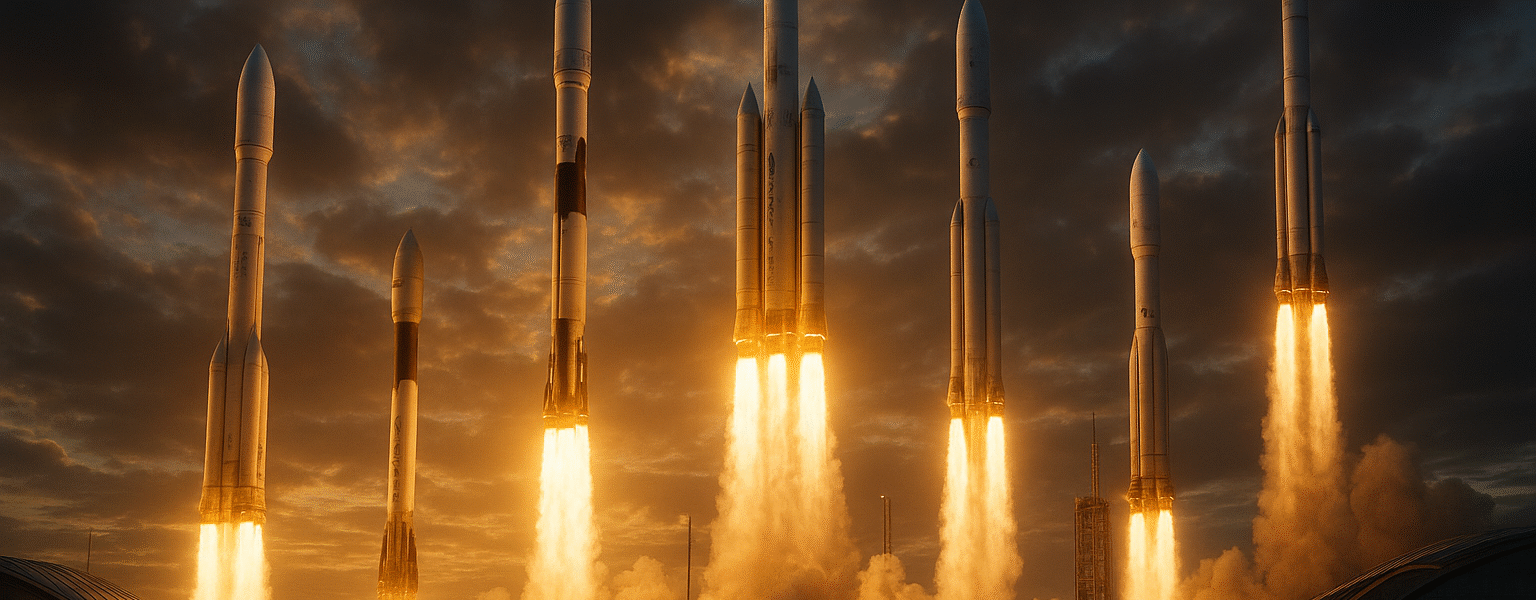

The global space industry is entering its most transformative era yet. What was once dominated by government agencies like NASA, Roscosmos, and ESA is now a fierce competition between billion-dollar private companies. Known as Space Race 2.0, this new chapter is being written by innovators who aim to make space travel cheaper, faster, and more ambitious than ever before.
At the heart of this shift lies a powerful trend: the rise of private space companies capable of achieving what only nations could accomplish a decade ago.
The Rise of the Private Space Sector
The first space race was political; the second is commercial.
Companies like SpaceX, Blue Origin, Rocket Lab, Virgin Galactic, and China’s Galactic Energy have transformed space exploration into a thriving global industry.
Key driving forces behind the private space race:
- Lower launch costs through reusable rockets
- Strong competition for government contracts
- Growing demand for satellite internet
- Increased investment from billionaires and tech giants
- Ambitions for lunar and Mars colonization
This shift has created a space ecosystem where speed, innovation, and cost-efficiency determine leadership.
SpaceX: The Undisputed Front-Runner
No company embodies Space Race 2.0 more than SpaceX.
The firm’s reusable Falcon 9 rocket, the powerful Starship platform, and the rapidly expanding Starlink constellation have set new benchmarks globally.
Major achievements:
- Record-breaking reusable rocket fleet
- Plans for Mars colonies
- Partnership with NASA for lunar missions
- Deployment of thousands of low-orbit satellites
SpaceX’s dominance has forced competitors to accelerate innovation to keep pace.
Blue Origin: The Challenger Rising
Funded by Jeff Bezos, Blue Origin is betting on long-term infrastructure rather than quick launches.
Its New Glenn heavy-lift rocket and Orbital Reef space station represent ambitions to build a permanent commercial presence in space.
Blue Origin’s goals:
- A future where millions live and work in space
- Commercial space station development
- Lunar lander missions in partnership with NASA
While slower than SpaceX, Blue Origin is emerging as a major competitor.
Rocket Lab and the Small-Launch Revolution
New Zealand–based Rocket Lab is disrupting the market with smaller, more efficient rockets designed for lightweight satellites.
Its Electron rocket is one of the world’s most reliable small launch vehicles, while its Neutron rocket aims to challenge mid-range launch providers.
China’s Private Space Boom
China’s private aerospace sector is growing at record speed, with companies like Galactic Energy, iSpace, and LandSpace achieving milestones once limited to state agencies.
Strategic advantages:
- Powerful government support
- Rapid tech manufacturing
- Aggressive innovation cycles
China’s rise is intensifying the global competition and reshaping geopolitical dynamics in orbit.
The New Frontier: Moon, Mars, and Beyond
Space Race 2.0 is not just about launching satellites.
It is a race to the Moon, the Mars surface, and future deep-space resources.
Private companies are exploring:
- Lunar mining for rare minerals
- Commercial Moon landers
- Mars colonization technology
- Space tourism and orbital hotels
- Point-to-point Earth travel via rockets
These projects could redefine humanity’s place in the universe.
The Economic Impact of Space Race 2.0
The private space sector is projected to become a $1 trillion industry by 2040.
Key growth sectors include:
- Satellite broadband
- Space tourism
- Deep-space mining
- Global navigation services
- Space manufacturing
As competition intensifies, prices will fall and innovation will accelerate.
Challenges Ahead
Despite its momentum, Space Race 2.0 faces hurdles:
- High development costs
- Regulatory barriers
- Orbital debris risks
- International tensions
How companies navigate these issues will determine leadership in the decades ahead.
Conclusion
The private space race marks a historic shift in global space leadership. The next great discoveries in orbit and beyond may not come from nations—but from innovative companies pushing the limits of science and engineering.
Space Race 2.0 is only beginning, and its impact will shape the future of humanity for generations.